
The history of Swedish ferries is also a history of engineering. Each new technology — steam engines, railway decks, drive-through vehicle decks, diesel engines, batteries — changed what a ferry could carry, how often it could sail and how passengers experienced the journey.
Early Passenger Vessels
Before the nineteenth century, few vessels were built specifically for passengers. Travellers crossed straits on sailing boats, rowing boats or cargo ships. On short crossings such as the Øresund, open boats carried passengers and small loads, while longer journeys across the Baltic were made aboard merchant vessels. Comfort was minimal and timetables were impossible because crossings depended on wind.
The Introduction of Steamships
Steam propulsion arrived in Sweden in the 1810s. Early steamers used paddle wheels driven by low-pressure engines and burned wood or coal. Their great advantage was independence from wind, which made scheduled departures possible. Over the century, iron hulls, more efficient compound engines and the screw propeller made steamships larger, faster and more economical. By the late nineteenth century, steamers served almost every significant Swedish passenger route.
Railway Ferries
A railway ferry carries railway vehicles on tracks laid along its deck. In port, the ship berths against a movable bridge — a linkspan or ferry slip — which aligns the ship's tracks with the rails ashore and adjusts for tides and loading. Locomotives push wagons aboard, and the wagons are secured for the voyage. The Helsingborg–Helsingør service from 1892 and the Trelleborg–Sassnitz Kungsleden from 1909 are key Swedish examples. Railway ferries required careful balancing because heavy wagons placed high loads on the deck.
The Rise of Automobile Ferries
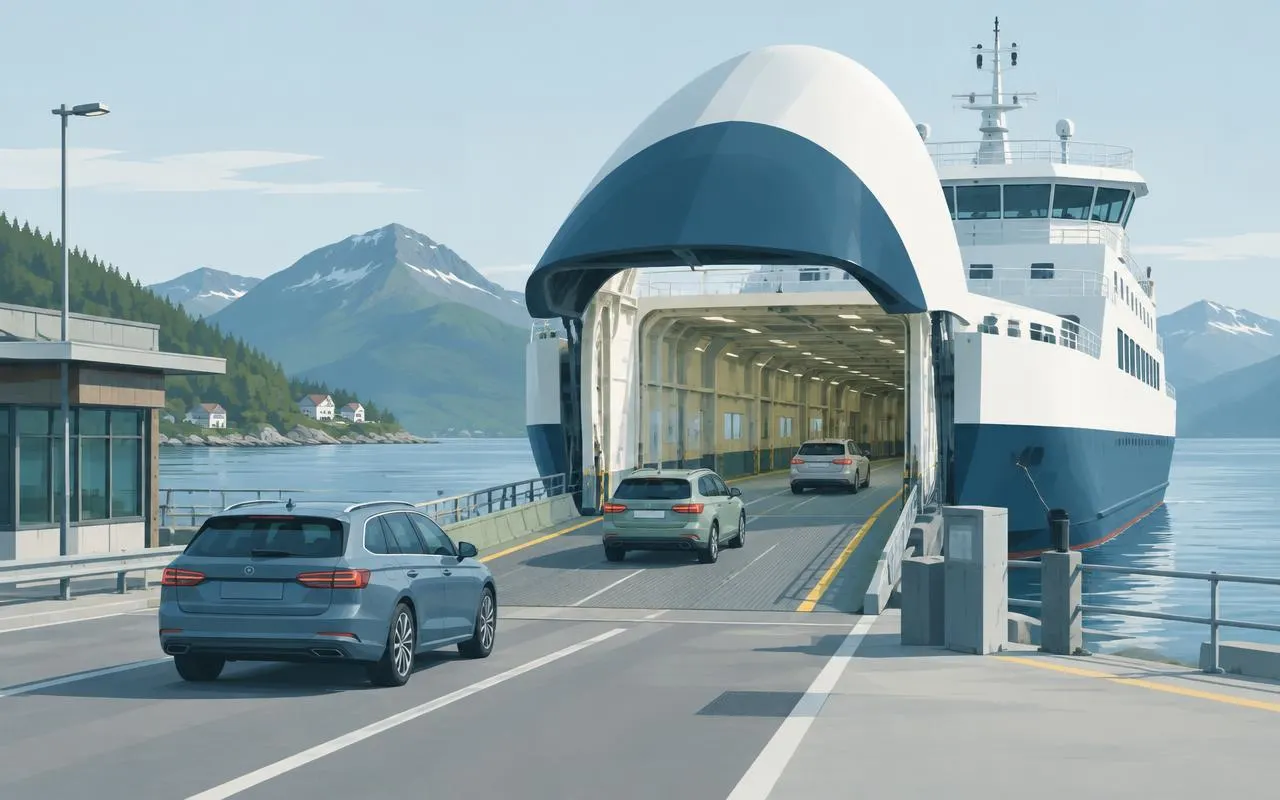
As car ownership spread after the Second World War, ferries needed to load vehicles quickly. Early methods, such as lifting cars aboard by crane, were slow. New ferries were designed with large, open vehicle decks that cars could drive onto via ramps, dramatically reducing loading times and enabling high-frequency services.
Roll-On/Roll-Off Ferry Technology
Roll-on/roll-off (ro-ro) ships have doors at the bow, the stern or both. A ramp connects the vehicle deck to the quay, and vehicles drive aboard under their own power. On double-ended ferries — common on short crossings like Helsingborg–Helsingør — vehicles drive on at one end and off at the other without the ship turning around. Larger ro-pax vessels (roll-on/roll-off passenger ships) combine multi-level vehicle decks with extensive passenger accommodation. Modern ships use internal ramps, hoistable car decks and bow visors or doors that seal watertight.
Passenger Facilities
Passenger facilities evolved from open decks to covered saloons on steamers, and then to restaurants, cafés, shops, cabins and lounges on larger ferries. Safety regulations developed alongside comfort. International conventions such as SOLAS (Safety of Life at Sea) set standards for lifeboats, fire protection and stability, and these were strengthened following serious accidents in European waters, including the loss of the Estonia in the Baltic in 1994.
Ferry Terminal Technology
Terminals changed with the ships. Railway ferry harbours needed track systems and ferry slips; car ferry terminals needed linkspans, marshalling lanes, check-in booths and road connections. Modern terminals add passenger gangways, freight areas for trailers, automated mooring systems and, increasingly, shore power and charging facilities for electric ferries.
The Evolution of Ferry Timetables
Timetables were the great promise of steam. Once departures could be predicted, ferries could connect with trains and coaches, and published schedules became part of national transport planning. On short, busy crossings, services evolved towards high-frequency "shuttle" operation, where ships depart at fixed intervals throughout the day. Today, digital timetables and real-time departure information are provided by operators; this website does not provide live schedules.
Modern Ferry Propulsion
Most twentieth-century ferries used diesel engines. In recent decades, operators have introduced cleaner technologies: liquefied natural gas (LNG), methanol, hybrid systems combining batteries with engines, and fully battery-electric ferries on short routes. In 2018 the Helsingborg–Helsingør ferries Tycho Brahe and Aurora were converted to battery-electric operation, recharging at each berth. Stena Line converted the Stena Germanica, sailing between Gothenburg and Kiel, to run on methanol in 2015.
Environmental Challenges
Shipping produces emissions of carbon dioxide, sulphur oxides, nitrogen oxides and particulates. The Baltic Sea has been designated a Sulphur Emission Control Area, with strict limits on fuel sulphur content. Ferries also face questions about underwater noise, discharges and energy efficiency. Shore power, hull design improvements and alternative fuels are among the responses.
The Future of Scandinavian Ferries
Future developments may include more battery-electric ferries on short routes, hydrogen or ammonia-based fuels for longer crossings, wind-assisted propulsion and greater automation in mooring and navigation. Ferries will also need to coexist with fixed links such as the Øresund Bridge and the Fehmarnbelt tunnel under construction between Denmark and Germany.
Technology Timeline
- 1810s
Steam arrives
The first steam vessels are built and operated in Sweden.
- 19th c.
Iron hulls and propellers
Screw propellers and iron hulls make steamships larger and more efficient.
- 1892
Railway ferry
Train ferries begin between Helsingborg and Helsingør.
- 1909
International train ferry
The Trelleborg–Sassnitz railway ferry opens.
- 1950s–1960s
Ro-ro car ferries
Drive-through vehicle decks become standard on Scandinavian routes.
- 1994
Safety reforms
After the Estonia disaster, ro-ro ferry safety standards are tightened.
- 2015
Methanol ferry
Stena Germanica begins operating on methanol.
- 2018
Battery-electric ferries
Tycho Brahe and Aurora begin battery operation between Helsingborg and Helsingør.