
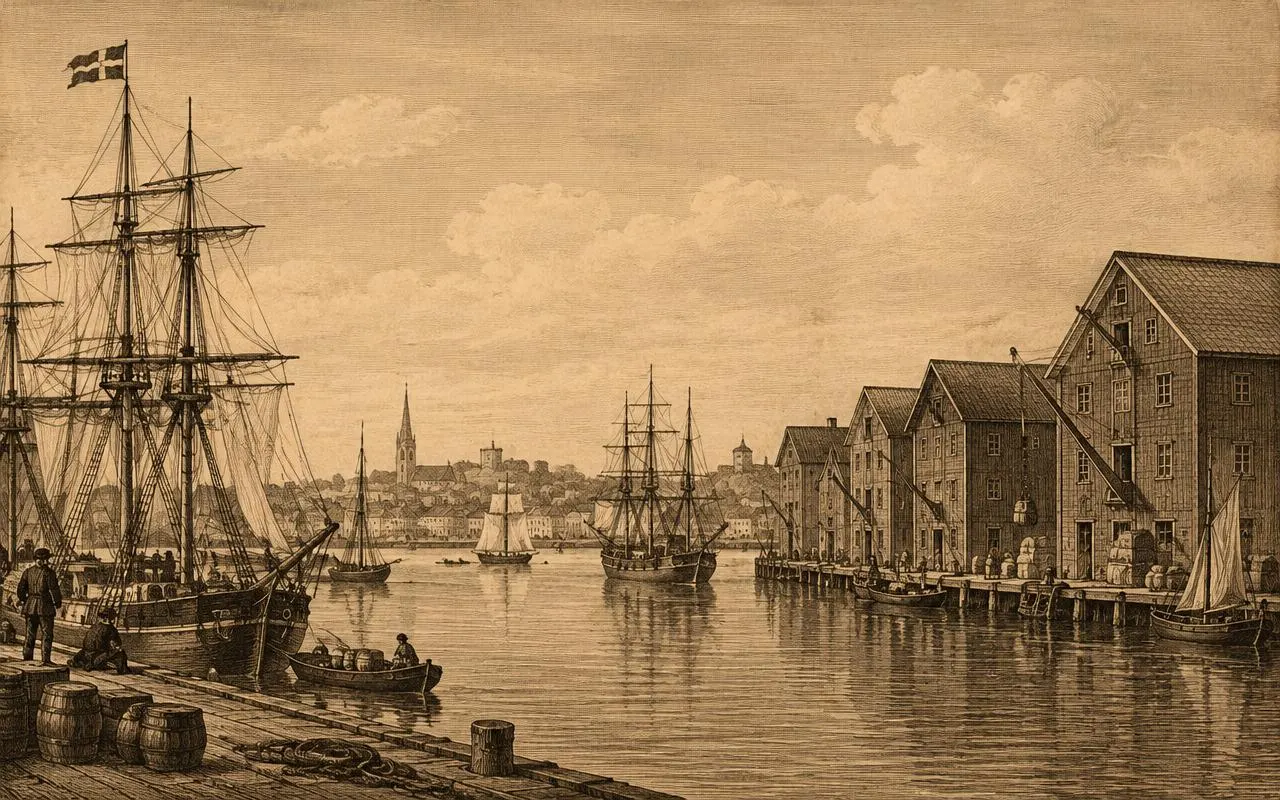
Ferries in Sweden did not appear suddenly with the steam engine. They grew out of a long relationship between people, coastline and sea — a relationship that shaped where Swedes lived, how they traded and how they connected with the rest of Europe. This chapter traces that relationship from early coastal settlement to the first scheduled ferry services and the growth of modern ports.
Sweden's Geography and Maritime Transportation
Sweden stretches roughly 1,500 kilometres from north to south, and most of its eastern and southern edge faces the Baltic Sea. To the west lie the Kattegat and Skagerrak, which open towards the North Sea. The coast is fragmented into archipelagos — the Stockholm archipelago alone contains tens of thousands of islands — and the large islands of Gotland and Öland sit offshore in the Baltic.
This geography made water transport essential long before modern engineering. Overland travel through dense forest and across marshes was slow, expensive and seasonal, while a boat could move heavy loads with a small crew. Lakes and rivers extended maritime routes inland. In winter, frozen waters in the north sometimes became roads of ice, but in the south, where the sea rarely freezes for long, boats remained the dominant link between communities.
Sweden's neighbours also lie across water. Denmark is separated from Scania by the Øresund; Germany and Poland are on the far side of the southern Baltic; Finland lies across the Gulf of Bothnia and the Sea of Åland. Any sustained contact with these neighbours therefore depended on shipping.
Early Coastal Settlements
Archaeology shows that people have lived along the Swedish coast since the end of the last Ice Age, when retreating glaciers exposed new land. Fishing, seal hunting and coastal trade sustained many early communities, and settlements tended to cluster around sheltered bays, river mouths and natural harbours.
Over time, some of these places became trading centres. Birka, on an island in Lake Mälaren, flourished as a market town in the Viking Age and is now a UNESCO World Heritage Site together with nearby Hovgården. Later medieval towns such as Visby, Kalmar, Söderköping and Stockholm all relied on access to the sea. The pattern repeated itself for centuries: wherever a good harbour met a useful route, a town tended to grow.
Viking Age Maritime Networks
Between roughly the late eighth and mid-eleventh centuries, Scandinavian seafarers developed remarkable ships — light, shallow-draught and capable of both sail and oar. From what is now Sweden, travellers and traders moved east across the Baltic and along the rivers of Eastern Europe, reaching as far as Constantinople and the Caspian region. Silver coins found on Gotland and elsewhere testify to the scale of this exchange.
It is important not to overstate the connection between these voyages and modern ferry routes. Viking Age sea travel was irregular, often dangerous and frequently linked to raiding or long-distance trade rather than routine passenger transport. What the period does show is that crossing the Baltic and the Øresund was already a normal part of Scandinavian life, and that maritime skill was deeply embedded in the culture of the region.
Medieval Baltic Sea Trade
After the Viking Age, Baltic commerce grew more organised. Towns received charters, merchants formed associations, and trade flowed in larger, heavier ships. Swedish exports such as iron and copper from the mining districts of Bergslagen, together with butter, hides, fish and timber, found markets across Northern Europe. In return, Sweden imported salt, cloth, wine, spices and manufactured goods.
Gotland held a special position in this period. Its central location in the Baltic made Visby a hub for merchants travelling between the west and the trading posts of the eastern Baltic, including Novgorod. Visby's medieval walls and churches, still remarkably intact, are a UNESCO World Heritage Site.
The Hanseatic League
From the thirteenth century onwards, the Hanseatic League — a loose association of mostly German merchant towns led by Lübeck — came to dominate trade on the Baltic and North Seas. German merchants settled in Swedish towns, and in Stockholm and Visby they formed an influential part of the population. The typical Hanseatic ship, the cog, had a broad hull and a large cargo capacity, well suited to bulk goods.
The Hansa's influence on Sweden was double-edged. It integrated Swedish ports into a powerful commercial system and brought skills, capital and goods, but it also gave foreign merchants considerable control over Swedish trade. When King Gustav Vasa built a stronger Swedish state in the sixteenth century, he gradually reduced the Hansa's privileges, and Swedish shipping began to develop more independently.
Passenger Transportation Before Steamships
Before the nineteenth century there were very few ships built specifically to carry passengers. Travellers usually took passage on merchant vessels, hired local boatmen or used official postal boats. On short crossings such as the Øresund between Helsingborg and Helsingør, small sailing and rowing boats ferried people, livestock and goods back and forth whenever weather allowed. Royal postal routes, including the postal connection across the Sea of Åland between Sweden and Finland, provided some regularity, but delays caused by wind, ice and storms were common.
Journeys across open water were uncomfortable and uncertain. A crossing that took an hour in good weather might be impossible for days in a gale, and travellers often waited in inns at harbour towns until conditions improved.
The Industrial Revolution
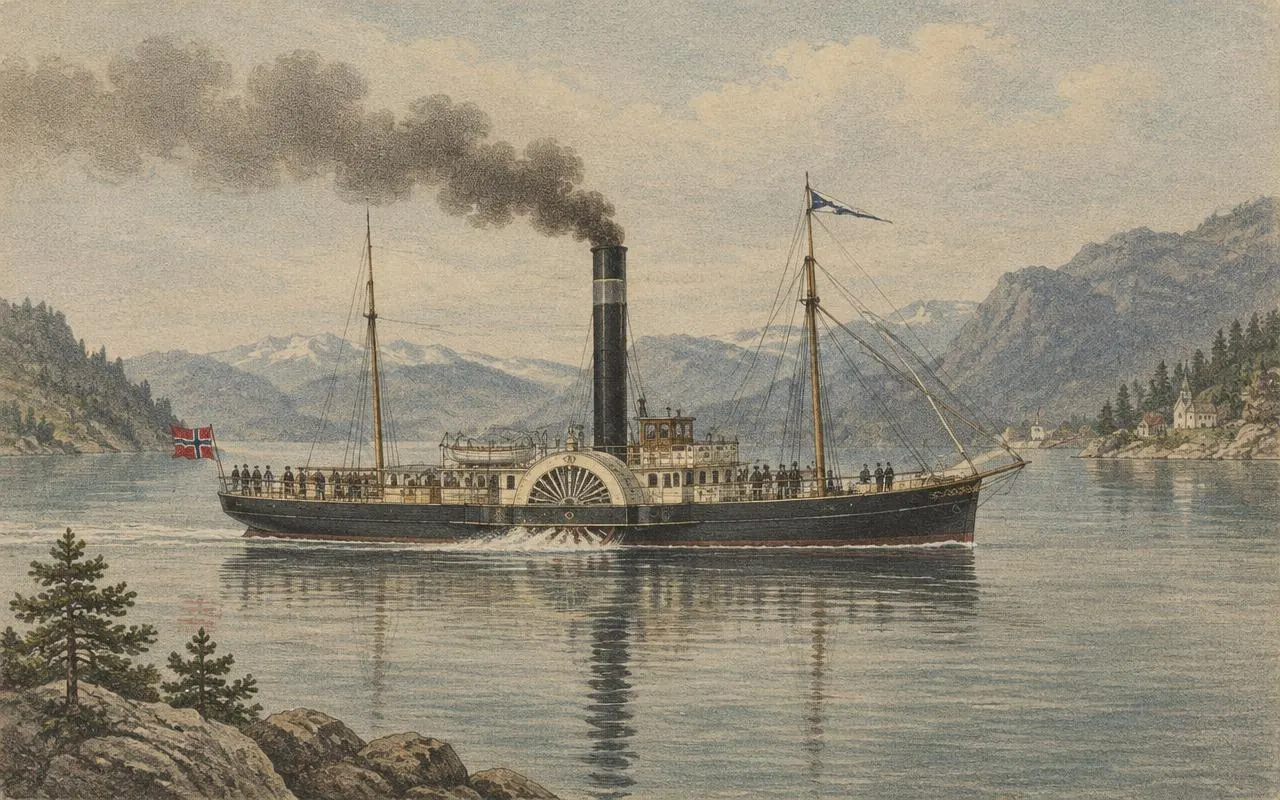
The nineteenth century transformed maritime transport. Steam engines freed ships from dependence on wind, iron and later steel hulls allowed larger and safer vessels, and the screw propeller gradually replaced paddle wheels. Sweden's first steam vessels were built in the 1810s; the British-born engineer Samuel Owen, who worked in Stockholm, is closely associated with these early Swedish steamboats.
Industrialisation also created demand. Sweden's timber, iron ore, pulp and engineering industries expanded rapidly in the second half of the century, and exports required reliable shipping. At the same time, the construction of a national railway network from the 1850s onwards linked inland regions to the coast, making ports the meeting point between rail and sea.
The Emergence of Scheduled Ferry Services
Steam power made timetables realistic. For the first time, a shipping company could promise a departure at a fixed hour and arrival within a predictable time, regardless of wind. Steamship lines began connecting Swedish ports with Denmark, Germany and Finland, and local steamers served archipelagos and lakes.
The next step was to connect railways directly across the water. In 1892 a railway ferry service started between Helsingborg and Helsingør, allowing railway wagons to be carried across the Øresund. In 1909 the Trelleborg–Sassnitz railway ferry opened, linking Sweden to Germany and onwards to continental Europe. These railway ferries turned a sea crossing into a link within an international transport system rather than a separate journey.
The Growth of Swedish Ports
As traffic increased, ports invested in deeper harbours, quays, warehouses, cranes and railway sidings. Gothenburg became Sweden's main gateway to the west and the Atlantic. Malmö and Helsingborg developed as Øresund ports, Trelleborg specialised in ferry traffic to Germany, and Stockholm, Kapellskär and Nynäshamn served routes to Finland, the Åland Islands, Gotland and the eastern Baltic. Ystad and Karlskrona became departure points for crossings to Bornholm and Poland.
In the twentieth century, the arrival of car ferries required yet another transformation: linkspans for vehicles, large marshalling areas, passenger terminals and road connections. The ports that adapted successfully became the backbone of Sweden's modern ferry network. Their history is explored further in our chapters on the Øresund, Sweden–Germany connections and ferry technology.
Historical Timeline
- 8th–11th c.
Viking Age networks
Scandinavian ships cross the Baltic regularly; Birka on Lake Mälaren flourishes as a trading centre.
- 13th c.
Rise of the Hanseatic League
German merchant towns led by Lübeck begin to dominate Baltic trade; Visby becomes a major hub.
- 1523
Gustav Vasa becomes king
The new Swedish state gradually reduces Hanseatic privileges and strengthens domestic shipping.
- 1658
Treaty of Roskilde
Scania, Halland and Blekinge pass from Denmark to Sweden, placing the eastern shore of the Øresund in Swedish hands.
- 1810s
First Swedish steam vessels
Early steamboats appear in Sweden, associated with engineer Samuel Owen in Stockholm.
- 1856
First major Swedish railway lines
The first sections of Sweden's public railway network open, beginning the link between inland regions and ports.
- 1857
End of the Sound Dues
The Copenhagen Convention abolishes the tolls Denmark had levied on ships passing through the Øresund.
- 1892
Helsingborg–Helsingør train ferry
Railway wagons begin crossing the northern Øresund by ferry.
- 1909
Trelleborg–Sassnitz railway ferry
The 'Kungsleden' links Swedish and German railways across the Baltic.