
Few stretches of water in Europe carry as much history as the Øresund. For centuries it was both a border and a bridge: a frontier between kingdoms, a source of royal revenue, a busy shipping lane and the shortest route between Sweden and Denmark. The story of ferry crossings between the two countries is, in large part, the story of this strait.
The Geography of the Øresund Strait
The Øresund (Öresund in Swedish) separates the Swedish province of Scania from the Danish island of Zealand. It is one of three Danish straits — together with the Great Belt and the Little Belt — that connect the Baltic Sea with the Kattegat and, beyond it, the North Sea. Because the Baltic has no other outlet, all shipping between the Baltic and the Atlantic has historically had to pass through one of these channels, and the Øresund has been the most heavily used.
The strait is about 118 kilometres long. At its northern end, between Helsingborg and Helsingør, it narrows to roughly four kilometres, which made this the natural place for crossings. Further south it widens, and the cities of Malmö and Copenhagen face each other across a broader stretch of water, with the islands of Ven and Saltholm between them.
Early Maritime Connections
People have crossed the Øresund since prehistoric times, and for most of recorded history both shores belonged to the same realm. During the Middle Ages, Scania was part of Denmark, and the strait was a domestic waterway rather than an international border. Boats regularly carried travellers, merchants and royal messengers across the narrows, and the herring fisheries off the Scanian coast — especially around Skanör and Falsterbo — attracted merchants from across Northern Europe to seasonal markets.
Trade Between Sweden and Denmark
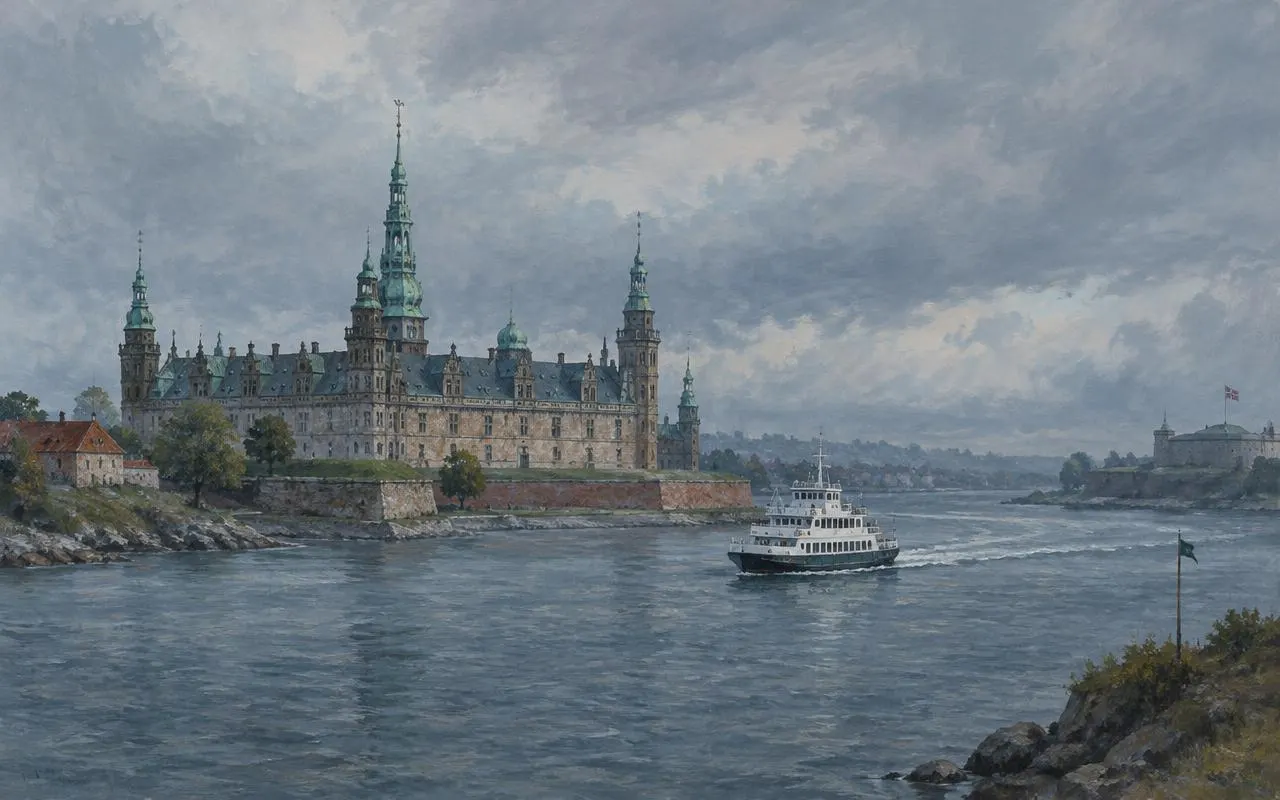
From 1429, under King Eric of Pomerania, Denmark began collecting the Sound Dues (Øresundstolden) from ships passing through the strait. The tolls were collected at Helsingør, overlooked by the fortress that later became Kronborg Castle. For more than four centuries, these dues were a major source of income for the Danish crown, and the records of the toll — the Sound Toll Registers — are today an important source for historians of European trade.
Alongside long-distance shipping, local trade crossed the strait constantly. Agricultural produce, fish, timber and manufactured goods moved between Scanian and Zealand towns, and family, cultural and religious ties connected communities on both sides.
Historical Political Relations
Relations between Sweden and Denmark were often hostile from the sixteenth to the early nineteenth century, with repeated wars for control of the region. The decisive change came with the Treaty of Roskilde in 1658, when Denmark ceded Scania, Halland and Blekinge to Sweden. From that moment the Øresund became a frontier, with Sweden on the eastern shore and Denmark on the western.
This had a direct effect on crossings: travel across the strait now meant moving between two states, with customs and border controls. Further wars followed, but after the early nineteenth century relations became peaceful. In 1857 the Copenhagen Convention abolished the Sound Dues in exchange for compensation paid by the seafaring nations, opening the strait to free navigation. In the twentieth century Nordic cooperation, including the Nordic Passport Union of the 1950s, made crossings far easier for travellers.
The Development of Passenger Ferries
Before industrialisation, passenger transport across the Øresund relied on small sailing and rowing boats operated by local boatmen, often under licences or privileges granted by the authorities. Services ran when wind and weather allowed, and travellers could wait for hours or days.
As traffic grew in the nineteenth century, more organised services appeared on both the northern crossing (Helsingborg–Helsingør) and the southern crossing (Malmö–Copenhagen). These services gradually acquired published departure times and dedicated vessels.
Steamships Across the Øresund
Steamships began crossing the Øresund in the first half of the nineteenth century. Their main advantage was reliability: a steamer could keep to a timetable whether or not the wind was favourable. Steamers also offered sheltered passenger accommodation, making the crossing more comfortable for ordinary travellers. By the late nineteenth century, frequent steamer services connected Malmö with Copenhagen and Helsingborg with Helsingør.
The Growth of Railway Connections
The railway age raised a new question: how to connect the Swedish and Danish rail networks across the water. The answer was the train ferry. In 1892 a railway ferry service began between Helsingborg and Helsingør, and train ferries were also introduced between Malmö and Copenhagen in the 1890s. Wagons could now be shunted aboard specially designed ships, carried across the strait and rolled off onto rails on the other side.
These links made the Øresund part of an international railway corridor. Freight and, later, passenger carriages could travel between Scandinavia and continental Europe without transhipping cargo, an enormous gain in efficiency.
The Expansion of Automobile Travel
After the Second World War, private car ownership in Sweden and Denmark increased dramatically. Ferry operators responded with vessels designed for vehicles, featuring drive-on, drive-off decks and frequent departures. The Helsingborg–Helsingør route became one of the busiest car ferry crossings in the world, with ships departing every few minutes at peak times. Hydrofoils and later catamarans also provided fast passenger links between Malmö and Copenhagen.
Modern Øresund Transportation
The opening of the Øresund Bridge on 1 July 2000 created a fixed road and rail link between Malmö and Copenhagen, and the ferry and fast-boat services between the two cities ended in the following years. The northern ferry route between Helsingborg and Helsingør, however, continued to operate and remains a vital local link. Today, the bridge and the ferry coexist, each serving a different part of the region — a pattern discussed in more detail on our Øresund Bridge page and in the history of the Helsingborg–Helsingør crossing.
Historical Timeline
- 1429
Sound Dues introduced
King Eric of Pomerania begins levying tolls on ships passing through the Øresund, collected at Helsingør.
- 1574–1585
Kronborg rebuilt
King Frederick II rebuilds the fortress at Helsingør as the Renaissance castle of Kronborg.
- 1658
Treaty of Roskilde
Scania, Halland and Blekinge pass to Sweden; the Øresund becomes a border between the two kingdoms.
- 1857
Copenhagen Convention
The Sound Dues are abolished, opening the strait to free international navigation.
- 1892
Railway ferry at the northern Øresund
Train ferries start between Helsingborg and Helsingør.
- 1950s
Nordic Passport Union
Passport-free travel between the Nordic countries simplifies crossings for travellers.
- 1991
Fixed link agreement
The Swedish and Danish governments agree to build a fixed connection between Malmö and Copenhagen.
- 2000
Øresund Bridge opens
On 1 July 2000 the road and rail link between Sweden and Denmark opens to traffic.